
Running a Sex Offender Check in Greene County
The Iowa Sex Offender Registry is administered by the Iowa Department of Public Safety, Division of Criminal Investigation. It is Greene County's authoritative online public lookup, and the county sheriff links to it. Searchers can begin with a name or use a geographic route to review registered locations around a city, ZIP code, or address.
The public registry view for Greene County shows only the portion Iowa law permits DCI to disclose. It does not reproduce the confidential law-enforcement registry. Nor does it list every person ever convicted of a sexual offense, every offense that does not trigger registration, or the full docket behind a conviction. For those reasons, a public result should be read as current registration information rather than a complete life history.
The official starting point appears in this Iowa registry image.
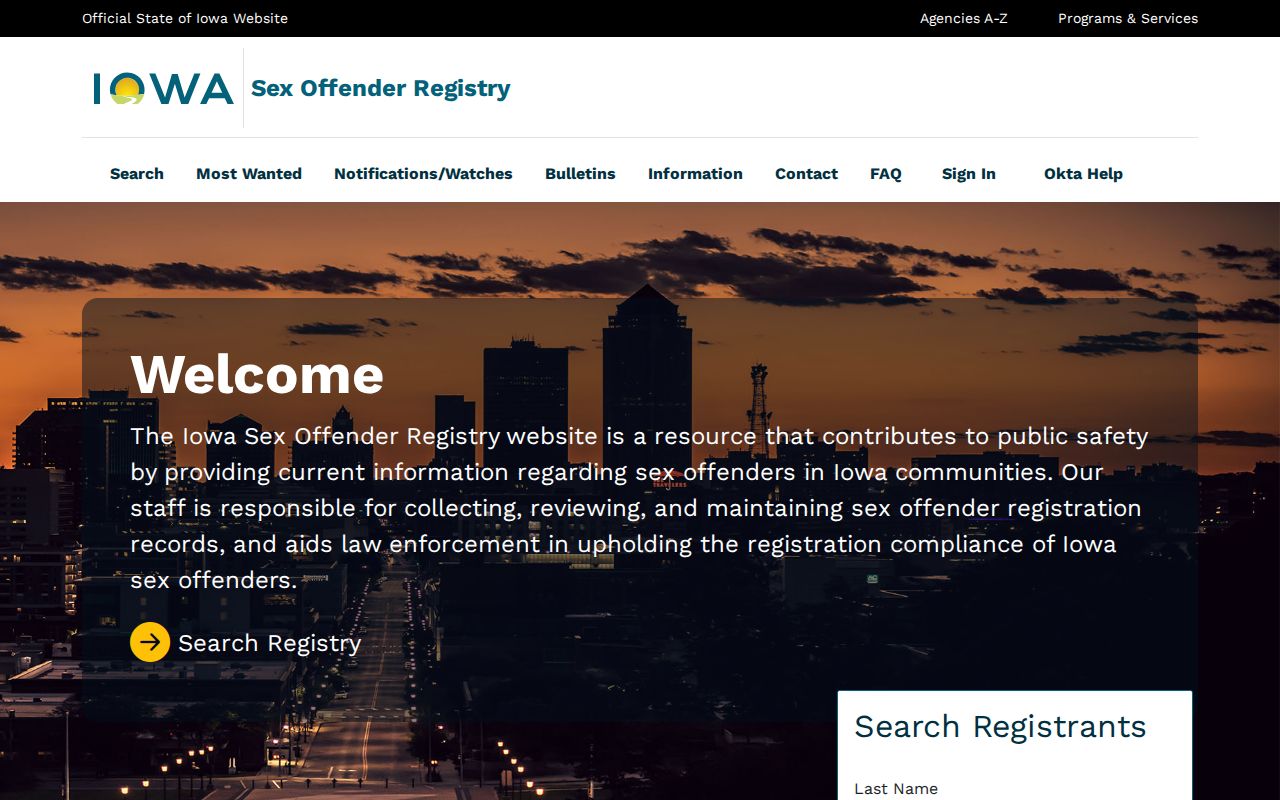
It provides the state warning and search routes that should be read before any Greene County result is opened.
Greene County Offender Name or Map
A Greene County name search is best when the reader already has an identity to confirm. First and last names can narrow the list, while spelling and alias information may affect the match. A county, city, or ZIP search answers a different question by finding registrants connected with a place. Address and radius controls use a street location as the center of the map.
Map dots do not rate a neighborhood and do not predict that an offense will occur. They show registered locations based on information reported by registrants and verified through the registry process. Address accuracy can change as updates move through that process. Check the profile status and details, then contact law enforcement about a suspected error instead of assuming an old or incomplete map point is current.
Searching the Iowa Sex Offender Registry
The official Iowa registry basic search may present a terms and warning gate before the search form. Read that notice each time because the interface and lawful-use directions can change. The fields below come from the state system inventory and should be used only as they appear in the live portal.
- Open the Iowa Sex Offender Registry and review its terms and warnings.
- Choose a name search or a geographic search based on the question being asked.
- Enter a last name, or select Greene County and add a city, ZIP code, or address when useful.
- Switch between map and list views, then open the matching public profile.
- Compare identifying details and status, and report a possible error to the sheriff or registry.
The terms-gated form is shown in this basic-search image.
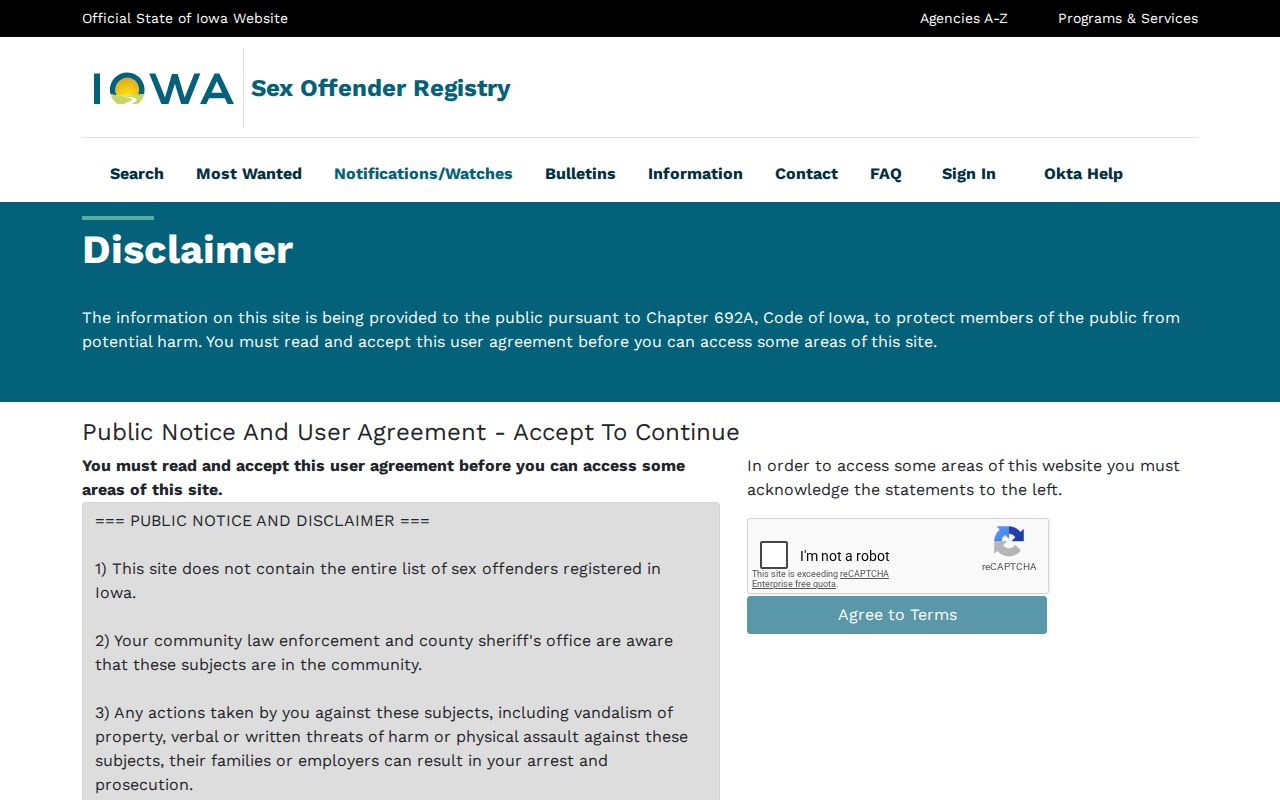
Its field choices allow a Greene County search to move from a broad county view to a more focused name or place result.
| Field or Control | Type | Use | Notes |
|---|---|---|---|
| Last Name | Text | Name search | Follow the live spelling or partial-match guidance |
| First Name | Text | Optional | Narrows a name result |
| City | Text or dropdown | Optional | Use a Greene County municipality |
| County | Dropdown | Optional | Select Greene |
| ZIP Code | Text | Optional | Five-digit geographic search |
| Address | Text | Map search | Sets the map center |
| Radius | Dropdown | Map search | Use distances currently shown |
| Map / List | Control | Optional | Changes the result presentation |
Greene County Registry Scope
The Greene County registry result answers whether a person is currently subject to public Iowa registration disclosure and what authorized fields are available. It is not a general background record, a police incident archive, or a full court file. An old conviction may not be publicly listed if no current public registration duty applies. A current profile may also omit data that is confidential under Iowa law.
For a filed Greene County case, read Iowa Courts Online and use the local clerk's docket channel rather than asking the registry to supply pleas, motions, or financial entries. For releasable statewide Iowa criminal history, DCI offers a separate record-check product. Keeping those layers distinct prevents a missing registry result from being mistaken for proof that no other criminal or court record exists.
What a Registry Profile Shows
A public Iowa profile returned for Greene County can combine identifying traits, status, location, and the offense information Iowa has authorized for release. Exact fields vary with legal classification and disclosure rules. Missing information should be treated as unavailable, not as proof that the fact does not exist.
| Identity | Name, aliases, photograph, and permitted age or birth information |
|---|---|
| Description | Sex, race, height, weight, hair, eyes, and scars, marks, or tattoos |
| Registry Status | Registration and compliance information available for public view |
| Location | Registration address or location, county, and related public place data |
| Offense | Description, statute, conviction jurisdiction and date, and permitted victim-age category |
| Other Registrations | Vehicle, work, or school information to the extent Iowa law permits |
The profile groups public facts in one place, but the statute controls which categories are visible for a particular record. Compare more than a name before treating a result as an identity match.
Greene County Public Registry Layers
Iowa Code chapter 692A makes registry records confidential except for information the law authorizes for public release. Law enforcement retains a broader registry for its work. This division explains why a public profile can appear detailed yet still withhold data found in the official law-enforcement record.
The governing chapter is shown in this chapter 692A image.
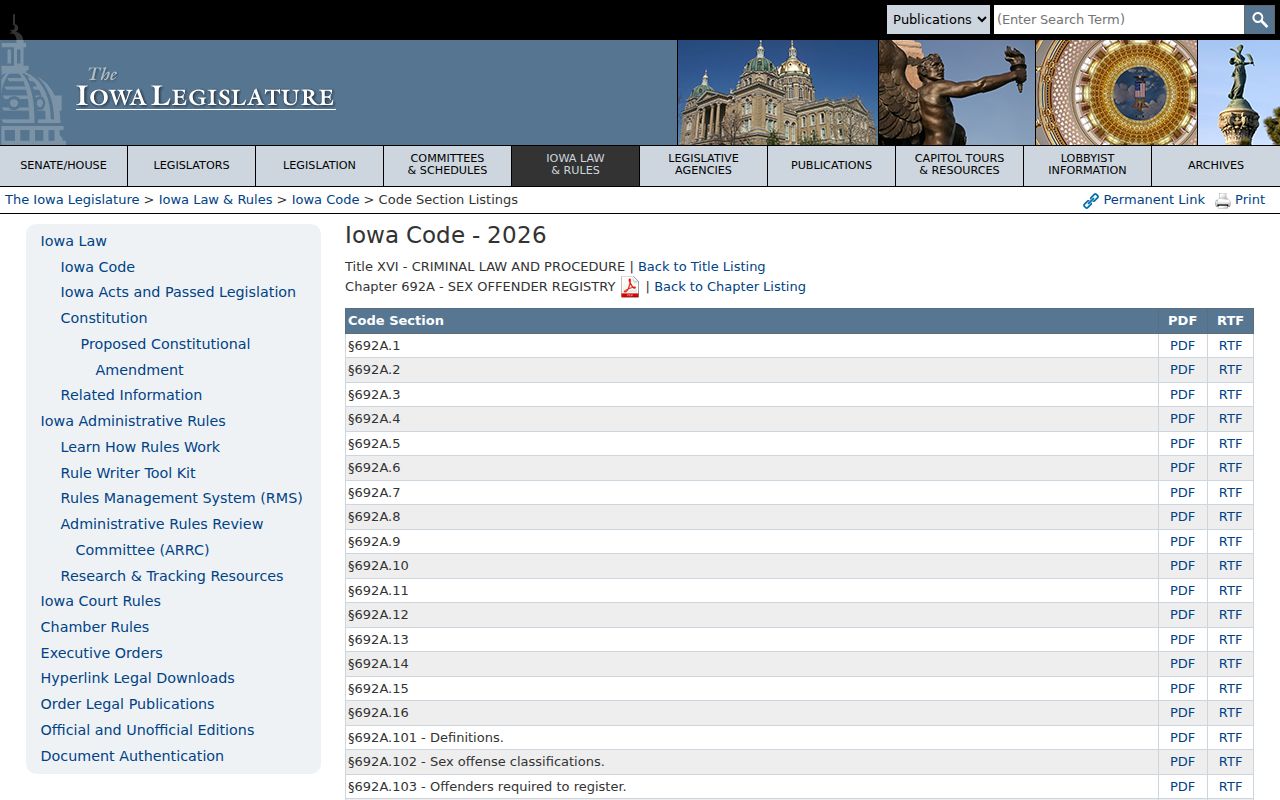
Its sections govern public disclosure, verification, duration, reporting, residency rules, fees, and penalties rather than leaving those choices to a local website.
When profile information looks wrong, save the public record location and describe the issue to the Greene County sheriff or DCI registry staff. Do not edit, republish, or confront the listed person. The source agency must review and correct its data.
Registration Requirements and Levels in Iowa
Iowa assigns Tier I, II, or III based on the registration-triggering offense. The tier is not an ordinary public risk score. It sets a verification frequency, while duration is calculated under a separate statute. A tier label alone cannot show the exact end date.
| Tier | Verification under §692A.108 | Duration Caution |
|---|---|---|
| Tier I | Annually | Tier I does not automatically establish a fixed duration |
| Tier II | Every six months | Duration is calculated separately under §692A.106 |
| Tier III | Every three months | The tier alone does not complete a duration calculation |
Iowa Code §692A.106 sets a default ten-year period, but special sentences, revocation, registry violations, repeat triggering convictions, aggravated offenses, sexually violent predator status, and outside-state duties can extend or create lifetime registration. Custody and revocation events can toll or restart time. The offense and adjudication date matter.
Chapter 692A also requires in-person verification and timely reporting of specified changes involving residence, work, school, vehicles, and travel. Frequency and duration answer separate questions. The tier tells how often verification occurs, while the duration statute, the triggering offense, and later events determine how long the duty continues. Ask the registering agency about a specific obligation instead of calculating it from a public tier label alone.
Greene County Offender Registration Office
The Greene County Sheriff's Office is the local law-enforcement contact for registration questions and suspected noncompliance. It is at 1005 E. Lincolnway, Jefferson, and can be reached at 515-386-2136. Administrative hours are 8:30 a.m. to 4:30 p.m. on weekdays. A registrant should call before visiting to confirm the reporting location, appointment practice, required documents, and current verification schedule.
No local registry appointment page or local fee schedule was published. The Greene County department directory provides another official route to local office details. Iowa Code §692A.110 sets an annual $25 fee payable to the sheriff of the principal residence and includes timing, installment, and inability-to-pay provisions. Call the office for the current Greene County procedure rather than assuming a payment method or walk-in practice. No county sheriff app or local notification app was documented.
Greene County Sheriff's Office
1005 E. Lincolnway
Jefferson, IA 50129
515-386-2136
Weekdays, 8:30 a.m.–4:30 p.m.
Greene County Offender and NSOPW Searches
The National Sex Offender Public Website adds a Department of Justice search across participating jurisdictions. It is useful when an address or identity crosses state lines. For an Iowa location, return to the Iowa registry for state-specific fields, terms, and reporting contacts.
The federal interface appears in this NSOPW search image.
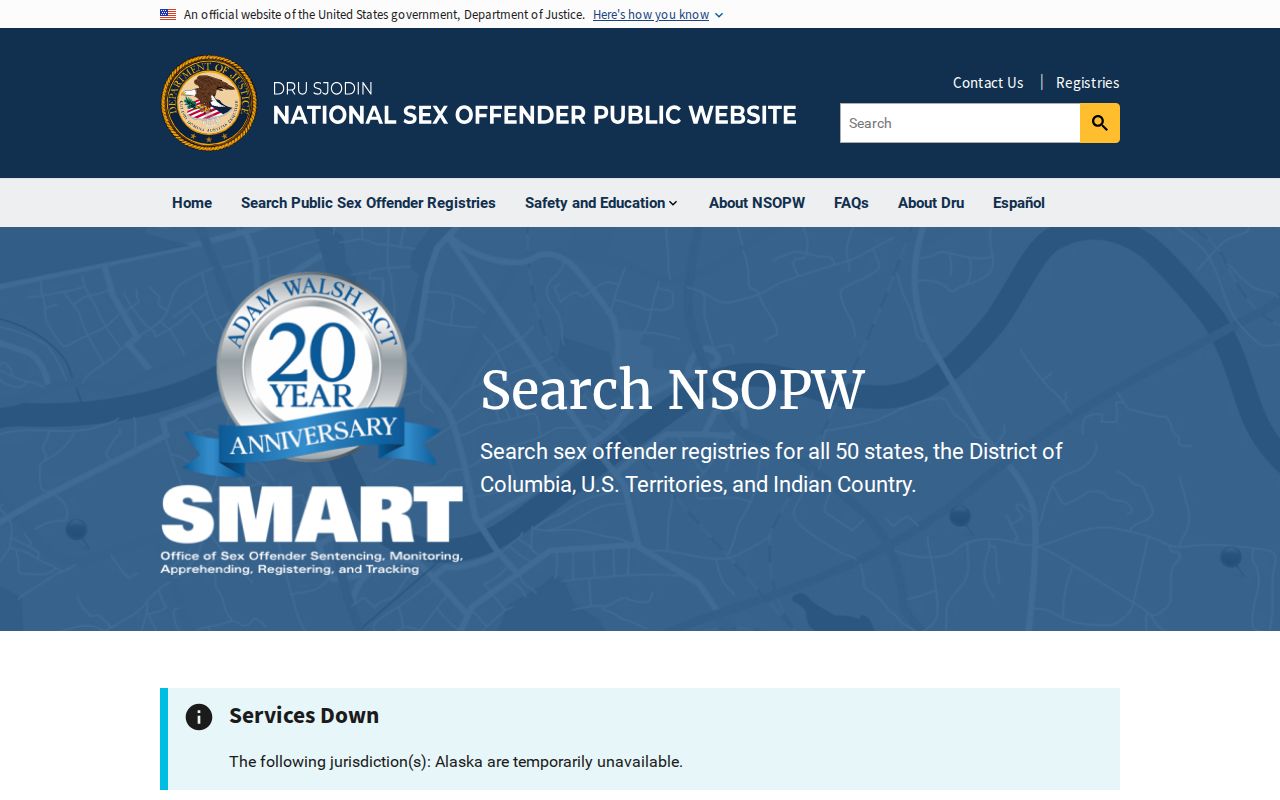
It broadens geographic coverage, while the Iowa portal remains the direct authority for the Greene County profile and local reporting path.
A national no-result also needs care. Participating jurisdictions apply their own public-disclosure rules and update schedules. Search the Iowa portal directly for a Greene County location, confirm likely identity details, and ask the agency that maintains the record when the two systems appear to disagree.
Note: Search both layers when a person or address has ties beyond Iowa, then verify each result with the jurisdiction that maintains it.
Lawful Use and Community Notification
Registry information supports informed personal and community safety choices. It does not authorize threats, harassment, discrimination, trespass, retaliation, or vigilantism. A map point is not an invitation to visit a listed address. If a reader suspects a reporting violation, the safe route is the Greene County sheriff. Call emergency services when there is immediate danger.
Iowa's residency rule is also narrower than a blanket claim that every registrant must live a set distance from every school. Iowa Code §692A.114 applies a targeted 2,000-foot restriction to specified offenders and includes exceptions. The profile, controlling statute, and law-enforcement guidance must be read together before drawing a conclusion about compliance.
The registry's official noncompliance and warrant interface is shown in this Iowa registry image.
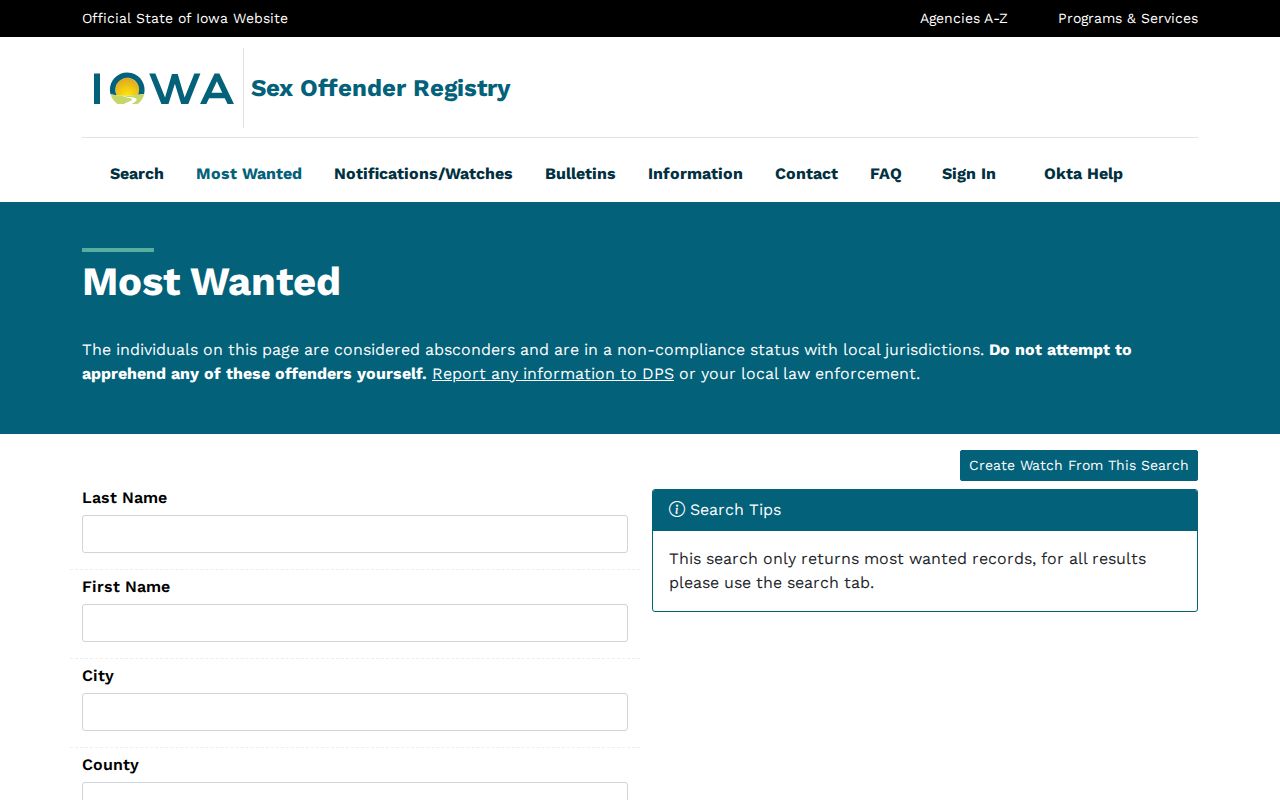
Use the official reporting route and let law enforcement investigate; never confront a person based on an online listing.