
Criminal Cases in the Greene County Courts
Greene County is part of Iowa Judicial District 2B and uses the unified Iowa District Court. There is no separate city municipal criminal court. District judges may hear any case and usually handle felonies, while district associate judges and magistrates exercise the narrower authority Iowa law assigns to them. The local building layout helps explain where proceedings occur: magistrate matters use a first-floor courtroom, the clerk works on the second floor, and the district courtroom is on the third floor.
The Greene County Clerk of District Court is the custodian of the official case file. The office records pleadings, evidence, orders, costs, fines, and court decisions, then sends orders to the agencies that must act on them. A police report or jail booking does not replace that court record. Once a complaint or trial information is filed, the docket becomes the best place to follow the accusation through dismissal, plea, trial, judgment, and sentence.
The official clerk page also shows the office behind the local docket. This Greene County clerk image comes from that source.
It gives searchers a direct local route when the statewide screen does not supply the document they need.
Greene County's Unified Criminal Court
A common search error is to look for a Jefferson or Grand Junction municipal criminal docket. Iowa instead routes these prosecutions through its unified District Court. The charge level can affect which judicial officer hears a stage, but the public case file remains with the Greene County clerk. The Iowa court directory is the authority for district and county routing.
The courthouse is at 114 N. Chestnut St., Jefferson, IA 50129. The clerk's Southeast Office is open weekdays from 8:00 a.m. to 4:30 p.m. and can be reached at 515-386-2516 or by fax at 515-383-3261. Staff can locate a specific record, but they cannot conduct open-ended research. Bring a name, case ID, and narrow date range. The Judicial Branch reporter guide lists ordinary copies at $0.50 per page, with possible added charges for supervised review or special work. Confirm the current price before ordering.
Greene County Clerk of District Court
114 N. Chestnut St.
Second Floor, Southeast Office
Jefferson, IA 50129
515-386-2516
Weekdays, 8:00 a.m.–4:30 p.m.
How to Search Case Records
Iowa Courts Online Search is the first stop for public Greene County criminal case records. Basic trial-case coverage is strongest from 1998 forward. A new filing generally appears after one business day, and existing electronic data then updates in real time. The portal can return a name match, but a match alone does not establish identity. Check the county, date information, case type, and docket details before drawing a conclusion.
- Open Iowa Courts Online and accept any current access terms.
- Search by party name, or choose the case-ID or citation mode when that identifier is known.
- Select Greene County and use date of birth, case type, or spelling variants to narrow the result.
- Open the Case ID and read each charge, event, disposition, and financial entry.
- Ask the Greene County clerk for public documents, older files, terminal access, or certified copies.
The official interface is shown in this Iowa Courts Online search image.
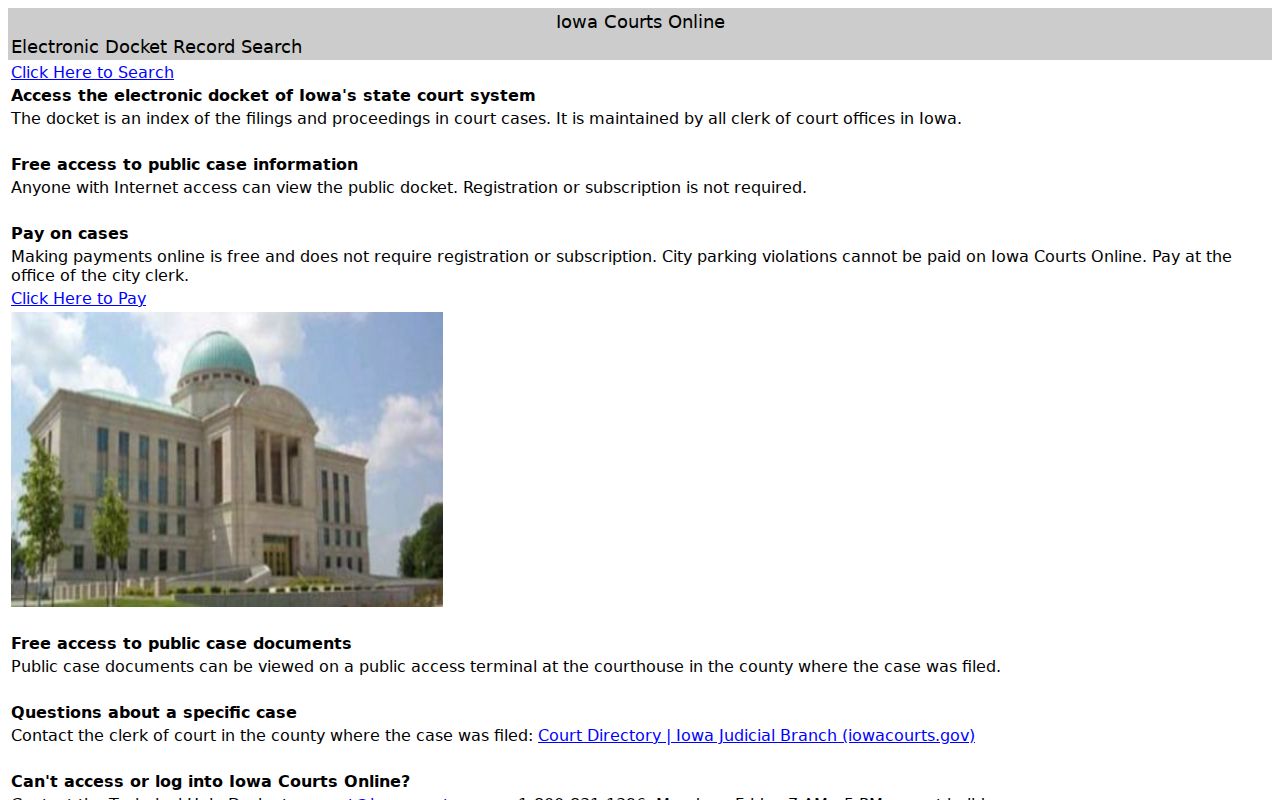
Its separate search modes reward precise identifiers, especially a full Case ID or exact citation number.
| Field Label | Type | Required | Notes |
|---|---|---|---|
| Last/Firm Name | Text | Name search | Two-letter minimum; % wildcard works |
| First and Middle Name | Text | No | Exact or partial values can narrow results |
| Date of Birth | Date | No | Exact first and last names are needed in exact-DOB mode |
| County | Dropdown | Case-ID mode | Select Greene for a local case |
| Case Type | Dropdown | Case-ID mode | Choose the displayed trial-case type |
| Case ID | Text | Case-ID mode | Seventeen characters; use uppercase letters |
| Citation Number | Text | Citation mode | Enter the exact citation number |
Greene County Case Update Timing
A newly filed Greene County criminal case generally needs one business day to reach the public search. Once it appears, electronic docket data updates in real time. That difference matters after a recent arrest: checking too soon can return no case even though filing work is underway, while an older open case may show a new event soon after the clerk enters it.
Wait through the normal initial lag, search again, and then contact the clerk if a known case remains absent. Ask whether the matter is awaiting public indexing, archived, or restricted. Do not infer a dismissal merely because the first search was early.
Older Greene County Case Records
A blank web result does not settle whether a Greene County case exists. Try a wildcard, another spelling, and the correct county before calling the clerk. For matters before 1998, the public index is less complete. Some older cases appear, while others remain in paper, microfiche, or another archived medium at the courthouse.
Public electronic documents may be viewed at a county courthouse terminal even when they are not freely downloadable through the web search. Bracketed detail links are free under the portal's help guide, while other functions can require a subscription or terminal visit. EDMS/eFile serves people who file court papers and requires an account. It is not the same product as Iowa Courts Online, and it is not the ordinary public-search substitute.
Note: A careful older-case request gives the clerk a name, likely filing years, and any known case number instead of asking for broad research.
What the Case File Shows
A Greene County criminal case record should be read count by count. The opening caption states an allegation, not an outcome. Later entries can show an amended charge, dismissal, guilty plea, trial finding, deferred judgment, or sentence. Financial screens may separate court costs, fines, restitution, surcharges, amounts paid, and balances. Public bond data can also identify the type, amount, dates, and disposition.
| Case Header | Case ID, type, filed date, judge, county, title, and status |
|---|---|
| Charges | Code, count, description, party association, and disposition |
| Docket Entries | Filed events, comments, dates, filing party, and current status |
| Parties and Counsel | Public names, roles, status, and attorney information |
| Disposition | Outcome for each count, including dismissal, acquittal, or conviction |
| Sentence and Money | Judgment, sentence terms, costs, fines, restitution, and payment data |
| Bond | Type, set and posted amounts, dates, agent, and disposition |
Read Greene County Case Outcomes
Three terms keep the Greene County docket in focus. A charge is the accusation listed for a count. A disposition is what the court did with that count, such as dismissal, acquittal, or conviction. A deferred judgment is Iowa's process for withholding judgment while a person completes set conditions. Its record treatment differs from an ordinary conviction and from expungement.
- Trial information
- The prosecutor's formal charging document in many Iowa indictable cases.
- Arraignment
- The stage when the filed charge is addressed and a plea is entered.
- Disposition
- The recorded outcome for one charge, not merely the case caption.
- Restitution
- Court-ordered payment for a qualifying loss, separate from a fine.
The Greene County Attorney reviews law-enforcement referrals and handles state prosecutions. The county source appears in this image.
That charging role explains why the filed court count may differ from the officer's first booking description.
Stages of a Criminal Case
A Greene County case can begin with an arrest or citation, followed by a complaint and initial appearance. Prosecutor review may then produce trial information or an indictment. Arraignment fixes the formal plea. Discovery and pretrial motions prepare the matter for a negotiated plea or trial. Judgment and sentencing follow a conviction, and an appeal can create a separate appellate record. The exact schedule depends on the case, so an old rotation calendar should not be used to predict a current hearing.
Case flow: Charges Filed › Arraignment › Pretrial › Plea or Trial › Disposition › Sentencing
When an arrest charge and court charge differ, keep both in their proper time frame. The booking record shows what the agency believed at intake. The filed count shows the prosecutor's action. The final docket shows whether that count changed and how it ended. For more on the first record in that chain, see the Greene County arrest history material.
Federal Greene County Criminal Cases
Federal prosecutions from Greene County belong to the U.S. District Court for the Southern District of Iowa, not the Iowa District Court docket. PACER is the official federal case-search and document system. Iowa DCI also states that its state criminal-history product does not include federal convictions, so a state check cannot stand in for a federal docket search.
This PACER image marks the federal access layer.
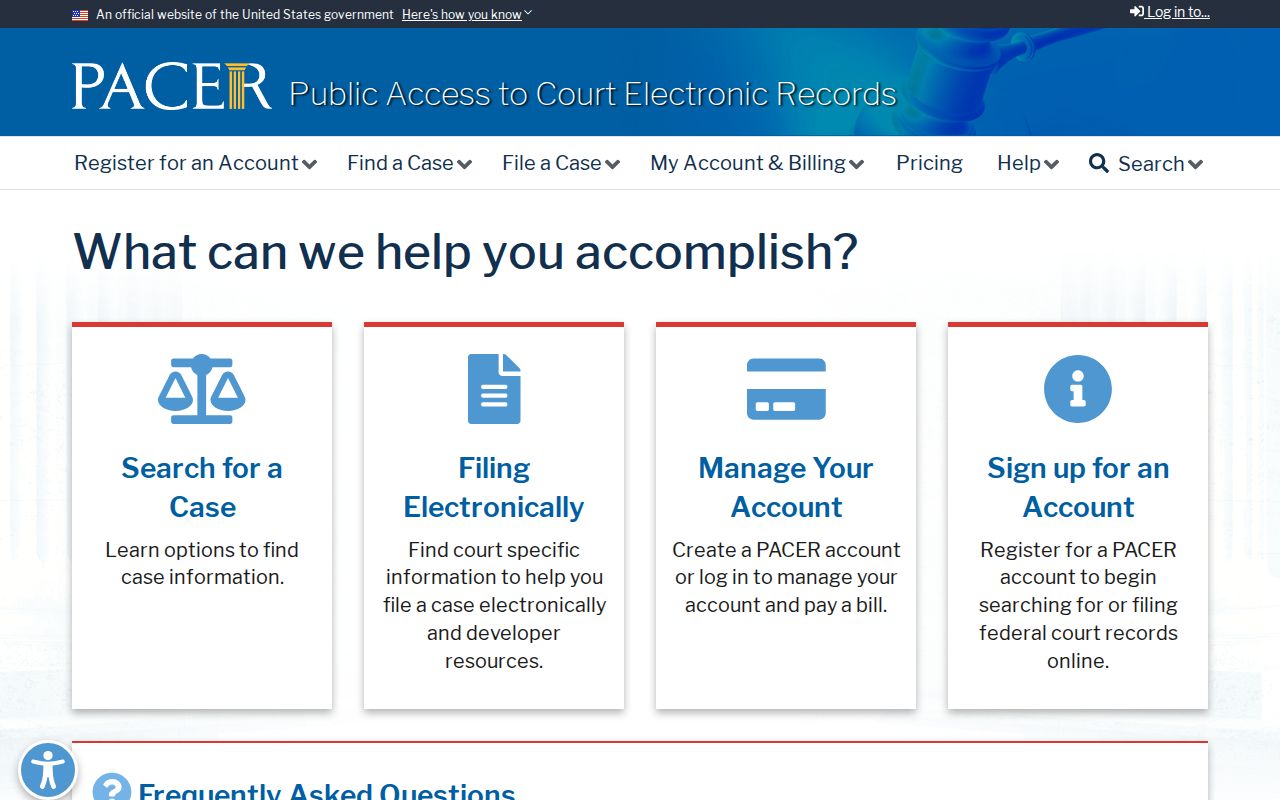
It should be used for federal filings, while the Greene County clerk remains the source for the local Iowa court file.
The relevant trial court is the Southern District of Iowa, shown in the following official-source image.
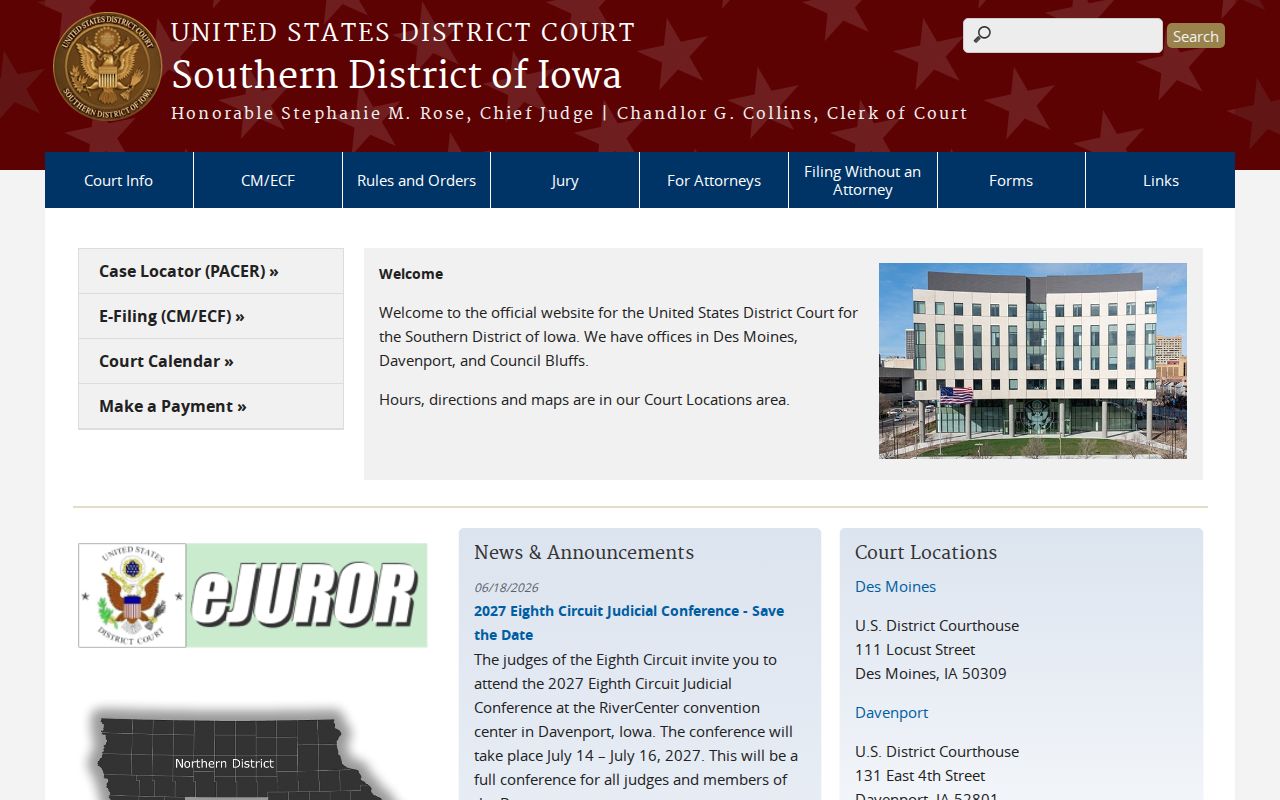
Greene County offices cannot certify records held by that federal court.
Access & Restrictions
Iowa Code chapter 22 supports inspection and copying of public records, while court rules and other statutes define what stays confidential. The Greene County department directory helps route a local request to the office that keeps it. Public Iowa Courts Online data can include parties, lawyers, filed events, charges, dispositions, and financial entries. Yet juvenile and confidential cases, expunged matters, presentence reports, protected identifiers, and some deferred-judgment material do not appear in ordinary public search.
Cases linked to an outstanding arrest or search warrant may remain confidential until service. Thus, no web result cannot safely prove that no warrant or case activity exists. If a known Greene County matter is absent, ask the clerk whether the file is older, restricted, archived, or available only through a courthouse terminal. A denial or redaction reflects an access rule. It does not erase the distinction between the court's file, the prosecutor's file, and the original agency report.