
How to Check Criminal History in Greene County
No county database combines every Greene County criminal record. Start with Iowa Courts Online for public District Court cases, then confirm what the docket says about each count. Court data is strongest for public trial cases after 1998. Some earlier cases appear, but an empty online result may require a spelling change, a one-business-day wait for a new filing, or help from the Greene County Clerk of District Court.
Gather the full name, spelling variants, approximate case date, and exact date of birth when it may lawfully be used. A name match is only a lead. Compare Greene County, birth data, case dates, charges, and disposition before treating two records as the same person.
- Search Iowa Courts Online by name and narrow the result to Greene County. Use a case ID or citation number when one is known.
- Open the case detail and read each charge, filing, status, and disposition. Do not treat the first charge caption as the final outcome.
- For a recent arrest or current jail status, call the Greene County Law Enforcement Center or Jefferson Police, based on the agency involved.
- Request the incident or arrest report from the agency that created it. Ask the sheriff separately for a booking record when needed.
- Order a DCI check for the releasable statewide Iowa history. Use DOC, federal, or registry channels only when that distinct record layer is relevant.
Greene County’s official government page provides the starting point for local departments and record custodians. View the Greene County government source used for that routing.

The county directory matters because a court file, sheriff report, and city police report must be requested from the office that actually keeps it.
Greene County's Three Record Layers
Three Greene County records are often mistaken for one. A sheriff or police record describes an investigation, arrest, or booking as the agency knew it at that time. The Iowa District Court file records the charge that was actually filed, later amendments, hearings, pleas, dismissal or conviction, sentence, and financial obligations. A DCI rap sheet links fingerprint-supported Iowa arrest cycles to dispositions and corrections data that were reported to the state.
The differences explain many apparent conflicts. A booking charge may be changed or dropped. A court case can exist even when a narrative report is partly withheld. DCI can omit an arrest if fingerprints were not submitted or withhold an old arrest when no final disposition is on file. The practical record flow is: arresting agency → booking and fingerprints → District Court filing and disposition → DCI criminal-history association. Each source answers a different question.
Official Iowa Background Checks
The Iowa Department of Public Safety, Division of Criminal Investigation runs the official statewide name-and-date-of-birth check. Any requester may submit the required Request Form and Billing Form. DCI searches by first name, last name, and exact birth date. Each last name costs $15, so a former or alternate surname needs another form and fee. Middle name, gender, and Social Security number are optional identity aids.
Greene County residents may submit requests online or send them by mail, fax, or email. In-person service is available at the Oran Pape State Office Building in Des Moines. DCI does not take requests by phone. Published processing guidance ranges from one to three days for common routes to a broader two-to-five-business-day expectation. Immediate walk-in results are limited to the person reviewing their own record with government photo identification.
The DCI criminal-history source shows the official request route and its limits.
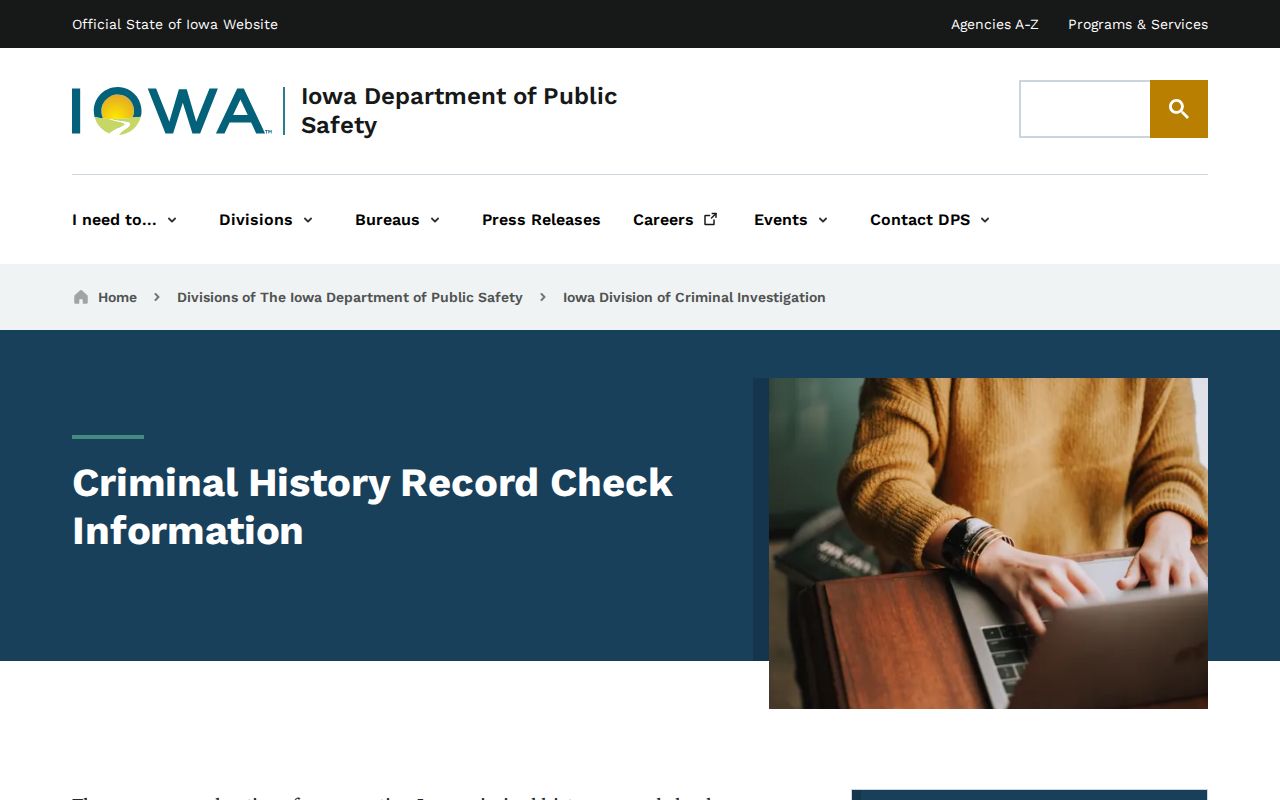
A DCI result is Iowa-only. It excludes federal convictions, FBI records, and other states, and confidential juvenile data never appears in the public product.
Iowa Courts Online Greene County Cases
Iowa Courts Online is Greene County’s main public docket search. Public trial cases generally appear about one business day after filing, then existing electronic data updates in real time. A basic name search accepts at least two letters in the last or firm name and supports the percent sign as a wildcard. Exact birth-date searching requires exact first and last names without wildcards. A known Case ID search also needs Greene County and the case type selected.
| Search field | Use | Greene County search note |
|---|---|---|
| Last or firm name | Required for name mode | Use two or more letters; the % wildcard is supported |
| First and middle name | Optional in basic mode | Helps narrow common names and spelling variants |
| Date of birth | Optional exact mode | Requires exact, non-wildcard first and last names |
| County and case type | Required for Case ID mode | Select Greene and the displayed trial-case type |
| Case ID or citation | Exact identifier mode | Case ID is 17 characters with uppercase letters |
Clicking a Greene County Case ID opens the detail. Public fields can include parties, charge codes, filings, status, disposition, bond, and financial balances. Not every filing is a free download, though public electronic documents may be viewed at a courthouse terminal. Juvenile, confidential, expunged, and some unserved-warrant cases are absent from public results.
Use the official Iowa Courts Online source for Greene County searches. Its result must still be checked against the subject’s identity and the final disposition.
Types of Criminal Records
A Greene County criminal-history search can involve several record products, each created at a different point. Arrest and incident reports belong to the law-enforcement agency. Booking data belongs to the jail. Complaints, trial information, judgments, and later orders belong to the Clerk of District Court. DCI maintains the releasable statewide criminal-history product, while Iowa DOC holds public offender and community-supervision fields.
- Arrest and booking records: show the initial custody event, intake data, charge as booked, bond, transfer, and release details that are public.
- Criminal court files: show what prosecutors filed and how each count moved through the Iowa District Court.
- DCI rap sheets: arrange fingerprint-supported Iowa arrest cycles with reported disposition and custody data.
- Warrant records: arise from judicial authority, though an unserved warrant and its case may remain confidential.
- Supervision and registry records: cover public DOC status fields or the public subset of the Iowa Sex Offender Registry.
The sheriff’s official description confirms the local jail and record contact. See the Greene County Sheriff source.
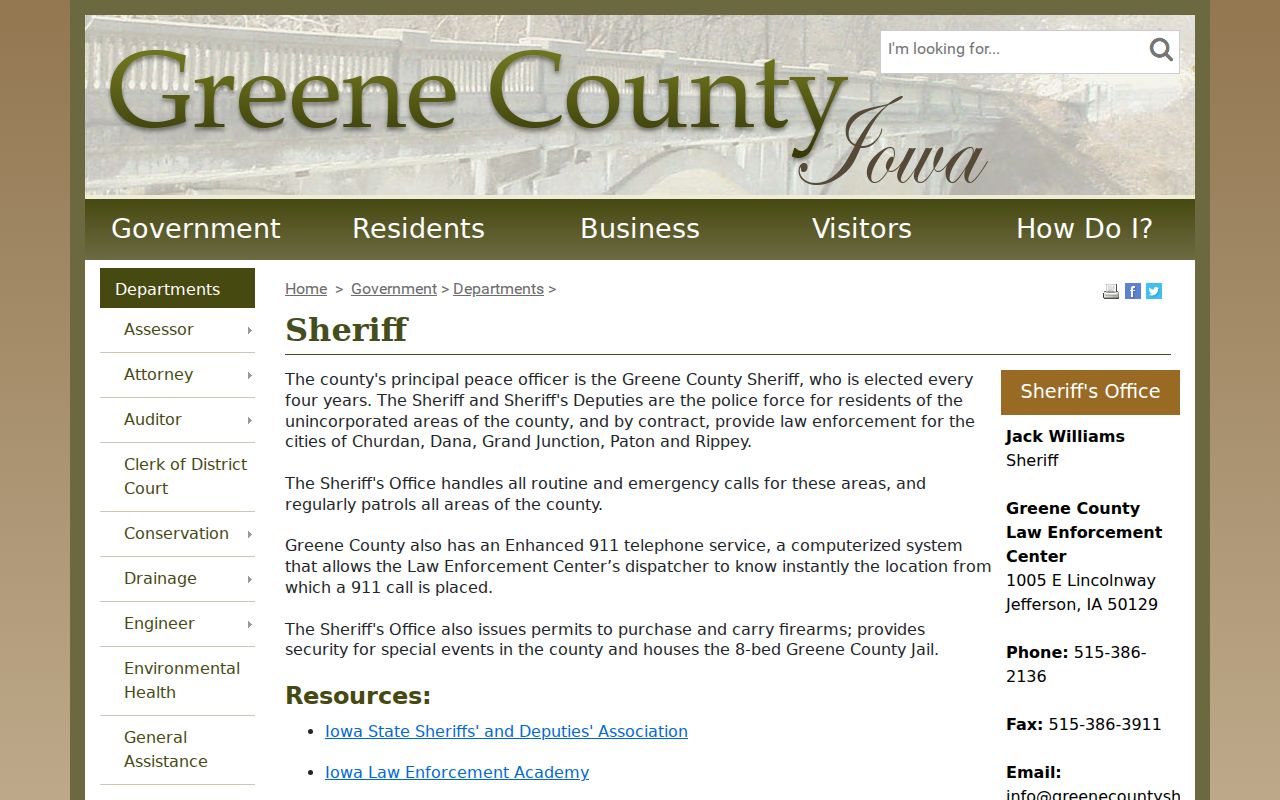
This local source is the right route for sheriff-created reports and current Greene County custody, not for certified court judgments or a statewide rap sheet.
Greene County Criminal Record Jail Gap
The current Greene County Jail has eight beds, yet the county publishes no official online roster, booking log, inmate profile, or local app. That gap makes the Law Enforcement Center phone line essential. Call 515-386-2136 for immediate or pretrial custody, ask whether a transfer occurred, and ask which public booking fields can be released. An unofficial inmate site is not an official substitute.
Use Iowa VINE for anonymous custody or status notifications. After a state sentence or transfer, search Iowa DOC Offender Search, which covers state prison, community programs, probation, and parole. DOC states that a new facility assignment generally updates within 24 hours after transport ends. A person disappearing from the small county jail channel may have been transferred, not released. Iowa Courts Online can then confirm the filed case, bond, and disposition.
The county has also pursued a new jail south of the present Law Enforcement Center. Procurement materials describe a 14,500-square-foot, single-story facility with 15 cells. That means 15 cells, not 15 beds, and the current completion or opening status should be verified before relying on the project schedule.
What a Greene County Criminal Record Shows
Greene County record fields depend on the custodian. A DCI record emphasizes fingerprint-linked identifiers, arrest cycles, and reported outcomes. A court docket has more detail about filings, judges, disposition, sentence, bond, and money owed. A booking record is strongest on intake, immediate charges, and custody movement. Reading the source label is as important as reading the data.
| Name & identifiers | Name, aliases, date of birth, state identification data, or fingerprint transaction details when part of that product. |
|---|---|
| Arrest & booking | Agency, arrest date, booking time, initial charge, intake identifiers, bond, release, or transfer fields that may be public. |
| Charges & statutes | Charge description, code citation, count number, complaint, trial information, or later amendment. |
| Disposition | The result for each count, such as conviction, dismissal, acquittal, or a specialized deferred-judgment outcome. |
| Sentence | Confinement, probation, fine, costs, restitution, surcharge, and related court orders. |
| Custody or supervision | Public status such as inmate, probationer, or parolee, plus permitted location and supervision data. |
- Disposition
- The court’s outcome for a specific charge, not merely the charge first listed.
- Deferred judgment
- An Iowa process that withholds judgment while conditions are completed; its record treatment differs from an ordinary conviction.
- Rap sheet
- A chronological fingerprint-supported state criminal-history summary, not a police narrative or full court file.
- Expungement
- A statute-based process that makes a qualifying Iowa case record confidential and directs specified record treatment.
When two sources differ, use the court disposition for the judicial outcome and the creating agency for its own event record. Neither one silently replaces the other.
Greene County Criminal Record Offices
Greene County’s records geography is split between two Jefferson locations. The courthouse holds adjudication records, while the Law Enforcement Center holds sheriff, booking, jail, and shared police operations. DCI in Des Moines remains a third channel for a statewide Iowa history. Naming the product before contacting an office avoids a partial answer.
Clerk of District Court
114 N. Chestnut St., Jefferson, IA 50129; 515-386-2516; weekdays, 8:00 a.m.–4:30 p.m. The clerk provides public dockets, case files, older records, courthouse-terminal documents, and certified copies.
Law Enforcement Center
1005 E. Lincolnway, Jefferson, IA 50129; 515-386-2136; business counter, 8:30 a.m.–4:30 p.m. weekdays. The center routes sheriff reports, booking and jail questions, warrant verification, and shared law-enforcement dispatch.
Greene County Attorney
114 N. Chestnut St., Jefferson, IA 50129; 515-386-5677; weekdays, 8:00 a.m.–4:30 p.m. The office holds prosecution and filed-charge context but does not represent private people.
The Clerk’s office is the fallback for files the web misses, especially older cases. Bring a full name, case number if known, and a narrow filing-year range.
Public Access Laws
Iowa’s Open Records Law applies to Greene County public records, but it does not make every part of a criminal file public. The request belongs with the office that created or keeps the record. A custodian may redact protected identifiers or withhold material made confidential by another law. The agency also need not create a new report just to answer a question.
Key Iowa laws:
Iowa Code § 22.2 gives the public the right to inspect, copy, and disseminate public records.
Iowa Code § 692.2 governs DCI dissemination and the limited public criminal-history product.
Iowa Code § 692.5 lets a person review and challenge their own Iowa criminal-history data.
Iowa Code chapter 901C sets eligibility and confidentiality rules for qualifying expunged cases.
Juvenile information, confidential victim or minor data, active investigative material, protected personal identifiers, expunged cases, and unserved-warrant matters can be restricted. Public access never authorizes threats, harassment, vigilantism, or misuse of registry data.
Greene County Criminal Record Fees
Greene County record costs depend on the product, not merely the person searched. Iowa Courts Online has a free basic docket search. The DCI charge applies once for each last name submitted. The FBI’s direct Identity History Summary is a subject-only federal self-check and needs fingerprints. Greene County has not published a sheriff report fee schedule, so the safe approach is to request an estimate before staff begin chargeable work.
| Record product | Scope | Published cost |
|---|---|---|
| Iowa DCI check | Releasable fingerprint-supported Iowa history | $15 per last name |
| Iowa Courts Online | Basic public Iowa docket search | Free basic search |
| Greene County sheriff record | Agency-specific report or booking material | Fee not located; ask for an estimate |
| FBI Identity History Summary | The subject’s federal identity-history file | $18 direct FBI, plus fingerprint costs |
| PACER | Federal court dockets and documents | $0.10 per page in July 2026 |
For a Greene County request, DCI can return encrypted PDF results by email and advises checking spam for a message containing “secureemail.” Payment choices on its forms include cash, check, money order, and listed credit or debit cards.
Sealed, Expunged & Restricted
Redaction and expungement do different work. Redaction hides protected portions of an otherwise public record. Expungement makes a qualifying case record confidential under Iowa law. Chapter 901C can apply to a case ending in acquittal or dismissal after required conditions are met, and it also has a narrower path for certain misdemeanor convictions. The misdemeanor route has an extensive exclusion list, a waiting period of more than eight years, paid-obligation conditions, and a general once-in-a-lifetime limit.
A discharged deferred judgment has separate treatment. DCI states that it retains the event as a discharged nonconviction and releases it only with signed authorization. Expungement also should not be described as physical destruction of every police narrative. Someone reviewing their own Greene County record after relief should keep the final order, allow processing time, obtain a new DCI result, and use the Iowa Code section 692.5 challenge route if official data remains wrong.
The Iowa Legislature publishes the controlling chapter. Consult the Iowa expungement law source before relying on a broad statement of eligibility.
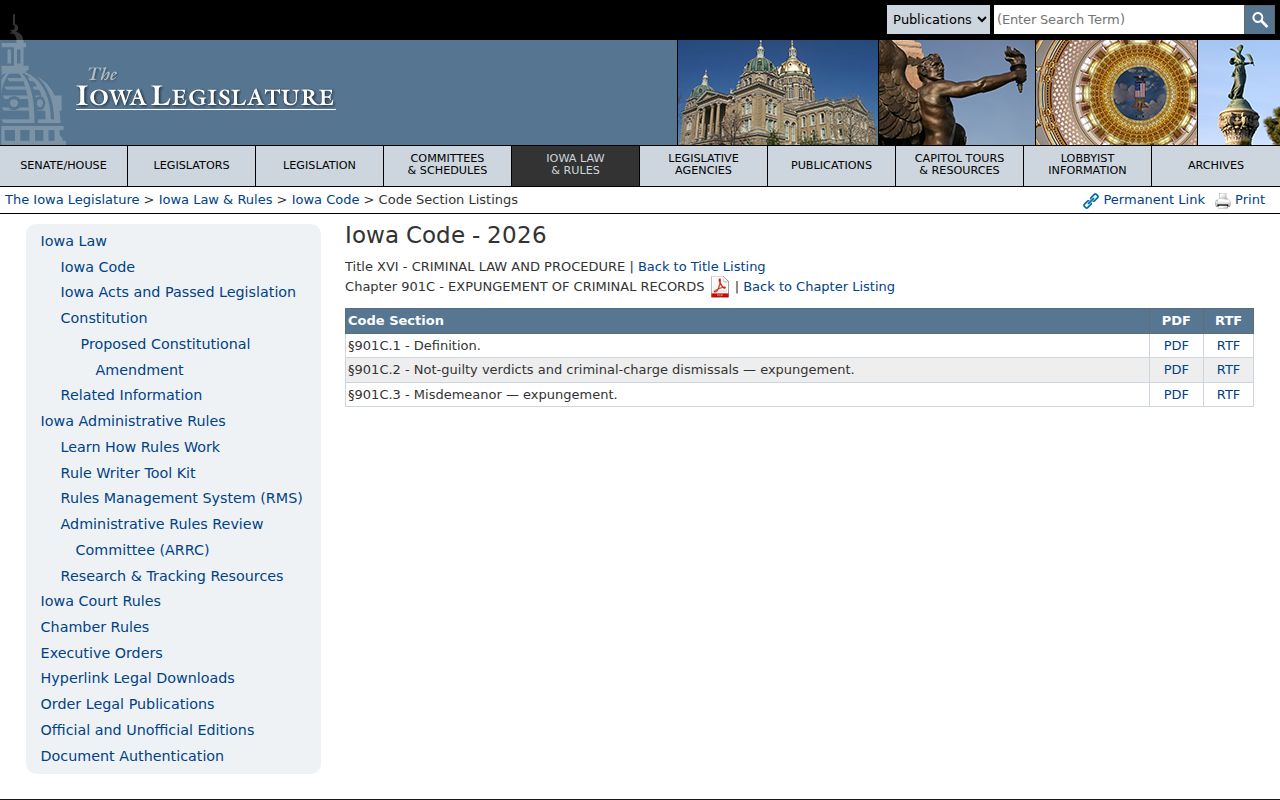
The statute shows why a missing search result cannot by itself prove that every agency record was erased.
Chapter 22 Greene County Record Requests
Greene County does not publish a dedicated sheriff records-request portal or local request form. Send a focused Iowa Code chapter 22 request by email, mail, fax, or in person to the creating agency. For sheriff records, the published contact is sheriff@greenecounty.iowa.gov, fax 515-386-3911, or the Law Enforcement Center. Jefferson Police creates Jefferson reports even though police and sheriff operations share the same building and nonemergency number.
State the record type, event date or narrow range, location, report or case number if known, and the names needed to locate the event. Ask for an electronic copy and a cost estimate. A useful request distinguishes an incident report, arrest report, booking entry, CAD record, 911 audio, crash report, or warrant inquiry. If part of the file is confidential, ask the custodian to separate and release the public portions.
No local clearance-letter product, certified booking fee, promised response time, notarization rule, or universal identification rule was verified. A written request creates a clear scope and response trail without inventing an office practice.
Greene County Criminal Custody Records
County jail custody, state correctional status, probation, and parole are separate layers. The Greene County Jail handles local and pretrial custody. Iowa DOC Offender Search covers state prison and listed community statuses after transfer or sentence. Probation is a court-ordered form of community supervision. Parole is conditional release decided by the Iowa Board of Parole and supervised through corrections.
The Iowa Department of Corrections source provides the state corrections route.

DOC public fields can include status, general location, supervision duration, supervision offenses, and county of commitment, but the result is not a Greene County jail booking profile. The Iowa Board of Parole source explains the separate decision authority.
Detailed supervision notes and a person’s home street address are not ordinary public lookup fields. Confirm the judgment in the court docket and the current status through DOC.
Criminal Records by City in Greene County
City location changes the first records contact, though filed criminal cases still enter Iowa’s unified District Court. Jefferson has its own police department at the shared Law Enforcement Center. The Greene County Sheriff provides contract policing in Grand Junction. Scranton is not named in the published contract list, and no current independent police page was found, so confirm the responding agency with city hall or the sheriff before requesting a report.
Jefferson Criminal History
4,150 · Jefferson Police creates city reports; county jail and District Court channels remain separate.
Grand Junction Criminal History
715 · Greene County Sheriff provides contract policing and holds the related agency reports.
Scranton Criminal History
493 · Confirm the current responding agency before sending a public-record request.
The population order follows the Census Bureau’s July 1, 2025 incorporated-place estimates. None of these cities has a separate municipal criminal-court portal; search Greene County cases through Iowa Courts Online.